
About Montessori Education
Montessori Philosophy
We believe in Human Tendencies
Children and adolescents are not merely recipients; they possess the potential and ability to fully develop their capacities. Montessori education focuses on meeting individual needs by offering challenging, hands-on lessons and encouraging collaboration rather than competition.
The absorbent mind
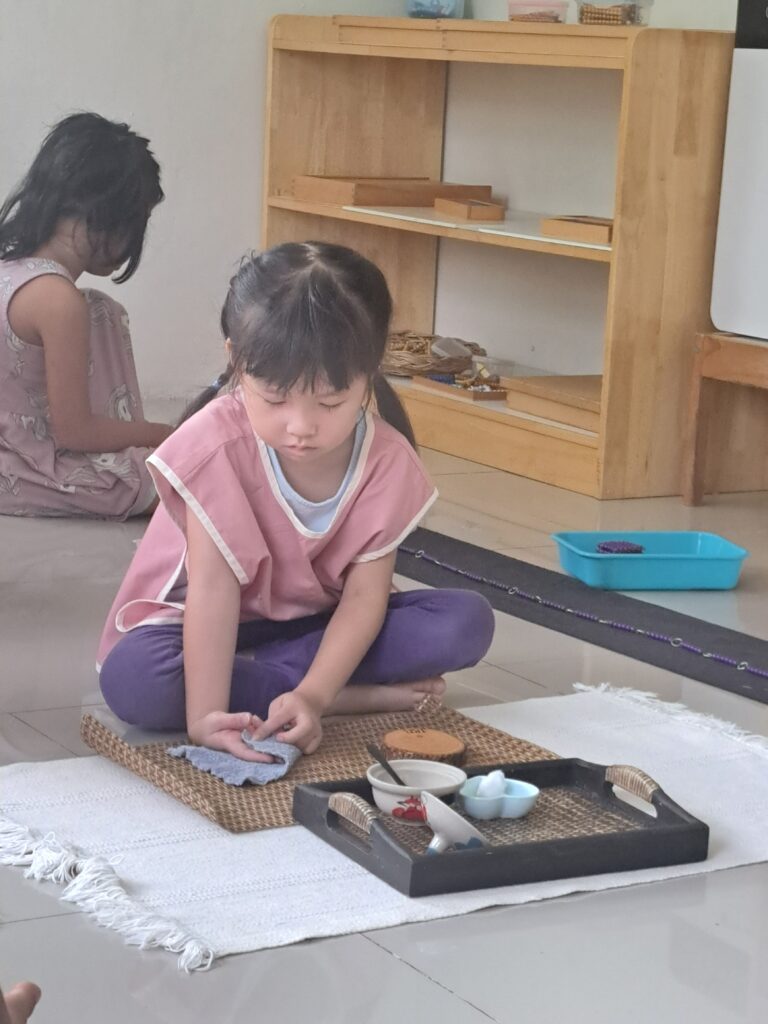
Children are naturally independent and capable. Adults must recognize the value of a child’s ability to learn, as children are essentially self-taught. The adult’s role is to serve as a guide to life. From birth to age six, children possess a unique ability known as the absorbent mind, through which they unconsciously absorb everything from their environment. Therefore, it is essential for adults to create a prepared environment that supports their development.
The sensitive period
Sensitive periods are an inner drive that guides children toward specific developmental goals. During these periods, children show a heightened interest in acquiring particular skills. The Montessori curriculum is carefully designed to align with these sensitive periods. For example, young children are often fascinated by small objects, so language lessons incorporate miniature items. Similarly, because children need hands-on, concrete experiences, Montessori math lessons utilize manipulatives to foster understanding.
The Primary years 3-6 years old
“These very children reveal to us the most vital need of their development, saying : ‘Help me to do it alone!'”
Maria Montessori.From Childhood to Adolescence.
Five Learning Areas
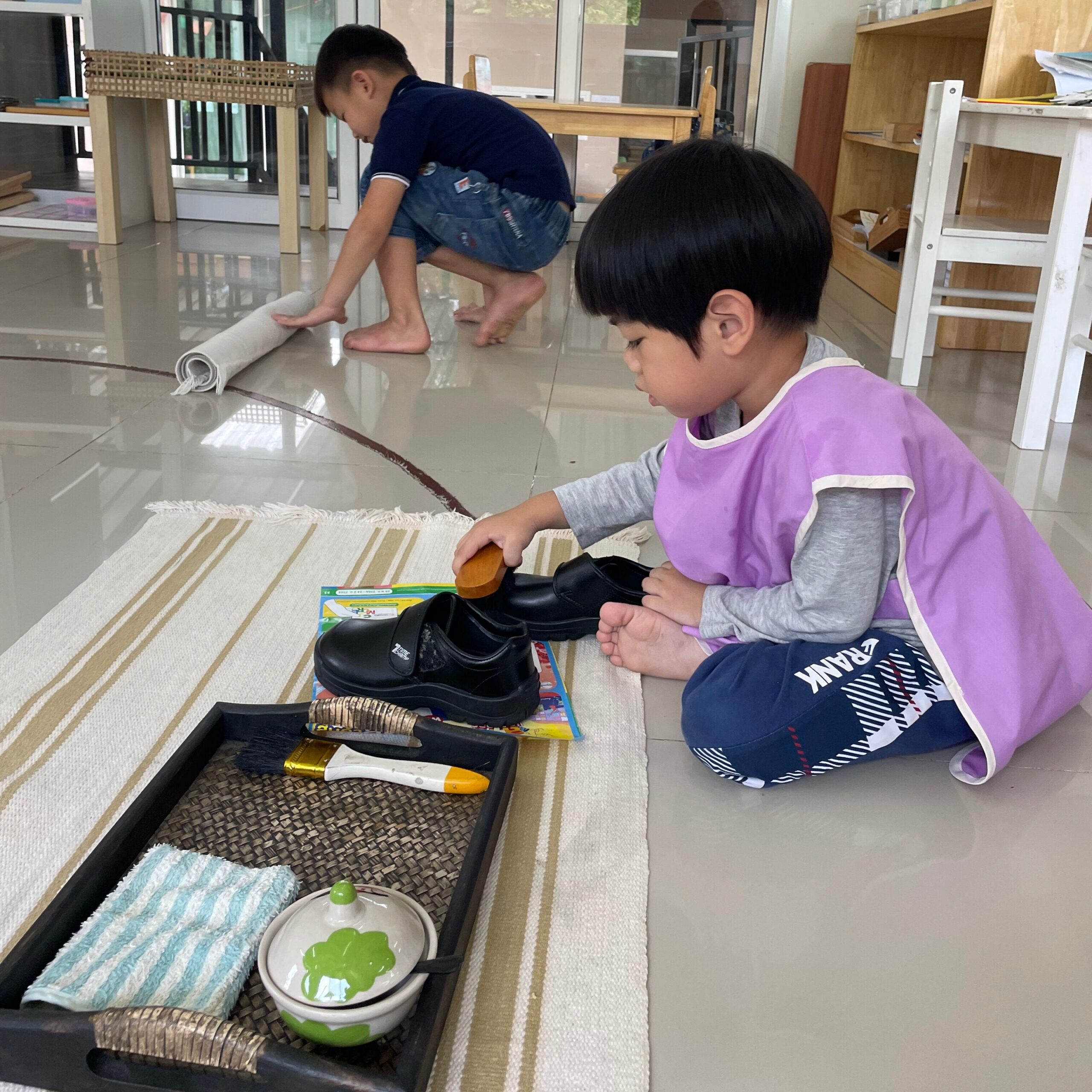
The Montessori primary years comprises of 5 areas of learning which are: Practical life, Sensory activities, Mathematics, Languages (English and Thai) and Cultural subjects (Science, Geography and History).
Uninterrupted Work Cycle
The three-hour morning work cycle is intentionally designed to give children uninterrupted time for focused activity. During this period, they are free to choose tasks from the five learning areas. The guide introduces lessons, and the children can engage with them at their own pace, continuing until they feel satisfied.
Repetition
Repetition is a distinctive aspect of Montessori education, rarely emphasized in other systems. It allows children the opportunity to master skills through continuous practice.
Freedom within limit
In a Montessori classroom, we embrace the principles of freedom of choice, freedom to repeat, and freedom to move. Children are free to choose activities based on their own interests, and the guide allows them to repeat tasks as often as needed to reach mastery. They also have the flexibility to work independently or in groups, on a mat or at a table, and may move around the classroom, without disturbing others.”
The Elementary Years
“Knowledge can best be given when there is eagerness to learn, so this is the period when the seed of everything can be sown, the child’s mind being like a fertile field, ready to receive what will germinate into culture. But if neglected during this period, frustrated in its vital needs, the mind of the child becomes artificially dull, henceforth to resist imparted knowledge.”
Montessori, M. (2007). To educate the human potential.
The Cosmic Education
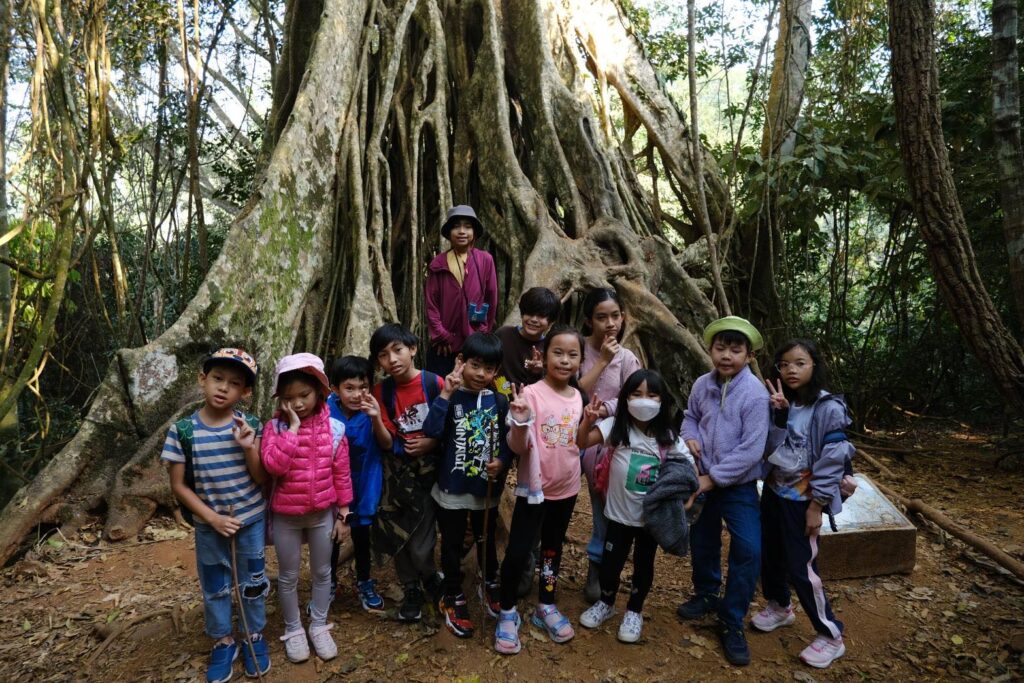
Cosmic Education is development response tailored to meet the hunger for knowledge in the second plane of development, aged 6-12 years old. Montessori recognizes that children in this stage possess a thirst for a capacity to use their imaginations and reasoning minds in service of intellectual pursuits, thus, its approach presents all things in the universe through the five great stories from the coming of the universe, the coming of life, the coming of humans, the coming of signs, and the coming of numbers that spark children’s imagination. It also aims to sow as many “seeds” of knowledge, planting the foundation for learning and research.
The reasoning mind and Imagination
Imagination in Montessori refers to the capability to form an image or a factual concept based on the child’s mind. This ability reveals in the second plane children. Montessori recognized that the child’s mind has an incredible ability to think in detail and create, making imagination a valuable tool for their development. Especially, the child’s mind at this stage has the ability to abstract. Imagination is grounded in reality rather than fantasy and fairy tales. She believed that children would be endlessly curious about the real world if it were presented to their imagination.